Vision, Values, and Vaults: How Saudi Banks Are Reshaping ESG Finance for the Global Stage
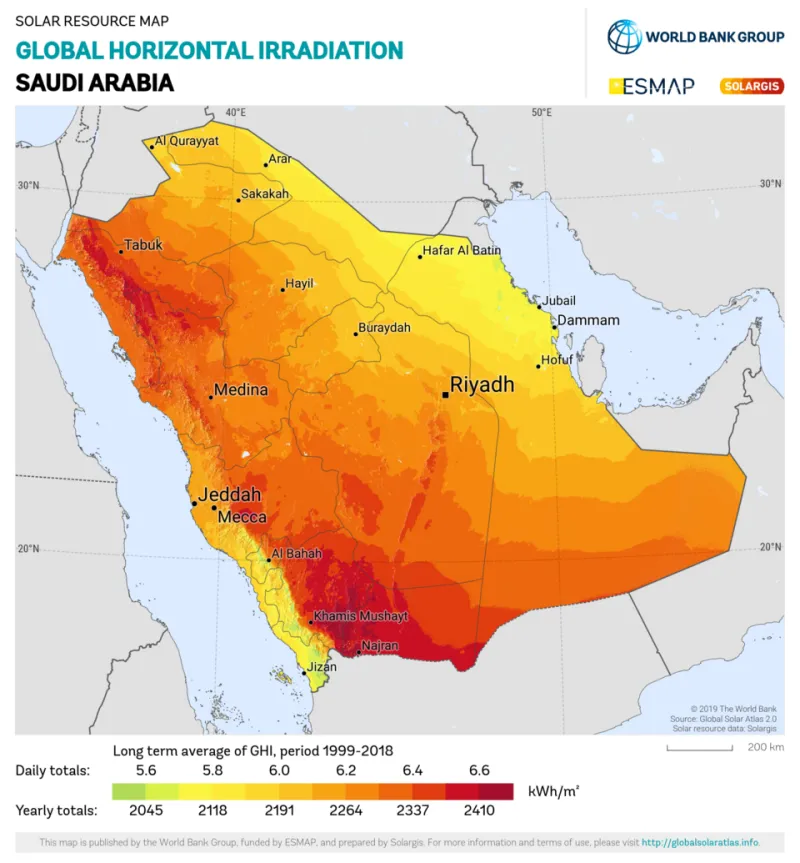
Photo: Solargis, CC BY 4.0, via Wikimedia Commons
The acronym ESG — environmental, social, and governance — has become a fixture of American investment discourse over the past decade, shaping portfolio decisions from Main Street retirement accounts to the allocation committees of the country's largest asset managers. Yet when US investors mentally map the global ESG landscape, Saudi Arabia rarely appears on that map. That omission is becoming harder to justify.
Driven by the Kingdom's Vision 2030 reform agenda and a pragmatic recognition that the global capital markets increasingly price sustainability credentials into the cost of financing, Saudi banks have moved with notable urgency to build out ESG-aligned product offerings. The result is a fast-evolving suite of green bonds, sustainability-linked lending facilities, and responsible investment funds that deserve serious attention from American investors who have written off the region on ideological grounds.
The Structural Driver: Vision 2030 as an ESG Catalyst
To understand why Saudi financial institutions are embracing sustainability-focused products, it is necessary to understand the broader economic transformation underway in the Kingdom. Vision 2030, the government's blueprint for post-oil diversification, sets ambitious targets across renewable energy, water conservation, urban development, and social inclusion — all domains that map directly onto the ESG framework.
Saudi Arabia has committed to generating 50% of its electricity from renewable sources by 2030 and achieving net-zero emissions by 2060. These are not aspirational statements decorating a government website; they are targets backed by capital allocation decisions affecting hundreds of billions of dollars in planned infrastructure investment. For banks operating in the Kingdom, financing this transition is not merely a reputational choice — it is a commercial imperative.
SAMA, the Saudi Central Bank, has reinforced this dynamic by issuing guidance encouraging financial institutions to integrate sustainability considerations into their risk frameworks and product development pipelines. The Capital Market Authority has similarly signaled its expectation that listed entities will improve ESG disclosure standards, creating regulatory momentum that is pulling the banking sector in a consistent direction.
Green Bonds and Sustainability-Linked Instruments
Saudi Arabia's debut sovereign green bond, issued in 2023, marked a symbolic milestone — the Kingdom formally entering a market long dominated by European and multilateral issuers. But the more significant story is unfolding at the institutional level, where Saudi banks have been structuring green and sustainability-linked instruments for corporate borrowers across the energy, real estate, and industrial sectors.
Al Rajhi Bank, the world's largest Islamic bank by assets, has been among the more active participants, issuing Sukuk structured to finance Shariah-compliant green projects — a product category that effectively merges Islamic finance principles with ESG criteria. This hybrid approach is genuinely novel: it creates investment instruments that satisfy both faith-based screens and sustainability mandates simultaneously, opening the door to a global investor base that spans Islamic finance markets in Southeast Asia and the Gulf alongside ESG-focused institutions in North America and Europe.
Saudi National Bank and Riyad Bank have similarly entered the sustainability-linked loan market, offering corporate clients financing terms that adjust based on the borrower's performance against agreed environmental or social key performance indicators. This structure, well established in European markets, is still relatively new to the Gulf — making Saudi Arabia an early regional adopter rather than a follower.
How These Products Compare to Western ESG Offerings
American investors evaluating Saudi ESG products through a familiar lens will find both points of resonance and meaningful differences.
On the positive side, many of these instruments are structured with third-party verification requirements and use-of-proceeds frameworks that align with internationally recognized standards, including the International Capital Market Association's Green Bond Principles. This means the documentation and reporting architecture will feel recognizable to US institutional investors accustomed to evaluating domestic green bonds.
However, the governance dimension of ESG — the "G" that American investors often weight heavily — presents a more complex picture in the Saudi context. Corporate governance standards, while improving under Vision 2030 reforms, differ from those prevailing in US or European markets. Board independence, minority shareholder protections, and executive compensation disclosure norms are evolving but have not yet converged with Western benchmarks. Investors applying a rigorous governance screen should conduct careful issuer-level due diligence rather than relying solely on a green or sustainability label.
The social dimension also carries regional specificity. Saudi Arabia's social progress metrics — including expanded female workforce participation, entertainment sector development, and youth employment initiatives — reflect a domestic reform trajectory that differs markedly from the social frameworks embedded in US ESG ratings methodologies. American investors may need to recalibrate their evaluation criteria to assess these developments on their own terms rather than through a direct transposition of domestic standards.
The Authenticity Question — and Why It Matters
No discussion of Gulf ESG finance is complete without acknowledging the skepticism that some Western investors bring to the table. Critics have raised legitimate questions about whether sustainability commitments from a major hydrocarbon producer represent genuine transformation or sophisticated reputation management — a concern that the financial media has labeled "greenwashing" in other contexts.
This is a fair question, and it deserves a nuanced answer rather than a dismissive one. Saudi Arabia's economy remains deeply tied to oil revenues, and the Kingdom's national oil company continues to expand production capacity. The tension between this reality and the ESG commitments being made by Saudi financial institutions is real and should not be papered over.
At the same time, the scale of the renewable energy investment underway in the Kingdom — including projects like NEOM's planned hydrogen economy and the massive solar installations being developed across the country — represents genuine capital deployment rather than marketing copy. The green financial products being structured by Saudi banks are, in most cases, financing actual low-carbon infrastructure rather than simply rebranding existing activities.
For US investors, the most intellectually honest approach is to evaluate Saudi ESG offerings on a project-by-project and instrument-by-instrument basis, applying the same critical scrutiny they would bring to any ESG product regardless of its geographic origin.
Accessing Saudi ESG Products From the United States
For American investors interested in gaining exposure to Saudi sustainability-linked instruments, the most practical routes currently include emerging-market bond funds with Gulf allocations, ESG-focused Middle East equity funds, and direct participation in Tadawul-listed instruments through international brokerage platforms.
As Saudi Arabia's capital markets continue to deepen their integration with global indices — the Kingdom's inclusion in the MSCI Emerging Markets Index has already brought significant passive inflows — the accessibility of Saudi ESG products for US-based investors will only improve.
The conversation about Saudi Arabia and sustainable finance is no longer a future possibility. It is a present reality, and the American investors who engage with it thoughtfully — bringing rigorous standards but also genuine openness — are best positioned to benefit from what may prove to be one of the more consequential sustainability transitions of the coming decade.